Britain's Bayeux Tapestry
Scene showing Harold being killed - 1885
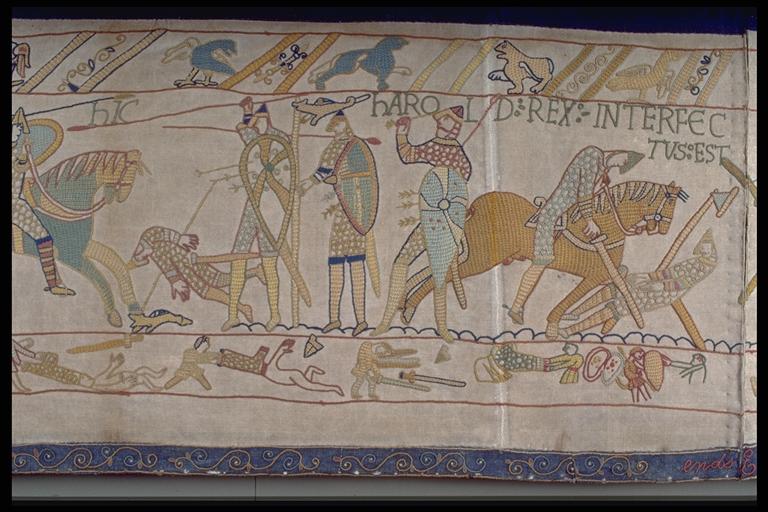
Bayeux Tapestry scene showing Harold killed
Harold's death is the Bayeux Tapestry's best known scene. By this point in the battle the Normans are looking stonger than the Saxons. This tapestry scene is hard to interpret and has led to many debates about which soldier is Harold and how he died. Is he the soldier shot through the eye with an arrow? Or is he the soldier hacked down by the Norman knight underneath the text that says 'Here King Harold was killed'?
It was the idea of Elizabeth Wardle to make a full-sized and accurate replica of the Bayeux Tapestry, 'so that England should have a copy of its own'. She was a skilled embroiderer and a member of the Leek Embroidery Society in Staffordshire. Elizabeth Wardle researched the Bayeux Tapestry by visiting Bayeux in 1885. The Society also based the replica on hand-coloured photographs held by the South Kensington Museum, now called the Victoria & Albert Museum. 35 ladies of the Society worked on the Tapestry and their names are embroidered into the bottom border. This section was embroidered by Mary Adeline Gwynne.
The replica was first exhibited in Leek's Nicholson Institute in 1886. Then it was displayed across Britain, Germany and America before being exhibited at Reading Town Hall in 1895. This exhibition was supported by Alderman Arthur Hill. His offer to buy the replica was accepted by the Leek Embroidery Society. He then presented the tapestry as a gift to Reading.
Museum object number