Mosaic pavement
From Silchester - Roman
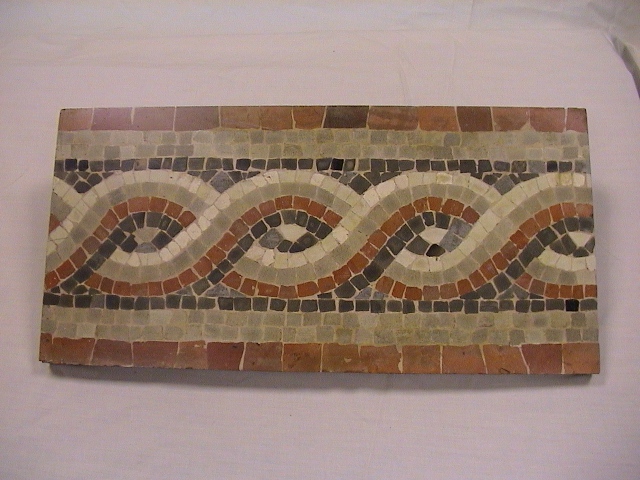
Mosaic pavement, Silchester
This piece of mosaic pavement was uncovered during excavations at the Roman town of Calleva by the Society of Antiquaries in 1893. Calleva is at Silchester, 10 miles south west of Reading. Each house uncovered in an insula was given a number. This piece of mosaic was found just inside the town’s south wall at insula VIII, house number 1. It initially came into the Museum on loan from the third Duke of Wellington and was later purchased from the eighth Duke in 1978.
This was a substantial house resembling an E in plan with an enclosed courtyard on its east side. The badly damaged remains of a mosaic floor were discovered in the room which projected into this courtyard on the west. The floor was divided into four squares by lines of this guilloche pattern but the motifs within the squares had not survived.
The mosaic was probably chosen from a pattern book containing designs and a range of individual motifs. Guide lines were scored or painted on the top layer of the foundation. The tesserae (the small cubes of material used to make the floor) were then laid in a thin bed of mortar spread over the guide lines a little at a time. Finally the floor was polished.
This fragment was reset and repolished soon after the 1893 excavation to try and show what a freshly polished new mosaic floor would have looked like.
The mosaic was purchased as part the Silchester Collection with the assistance of the Art Fund and the Victoria & Albert Purchase Grant Fund.
Museum object number