Shale table top
From Silchester - Roman
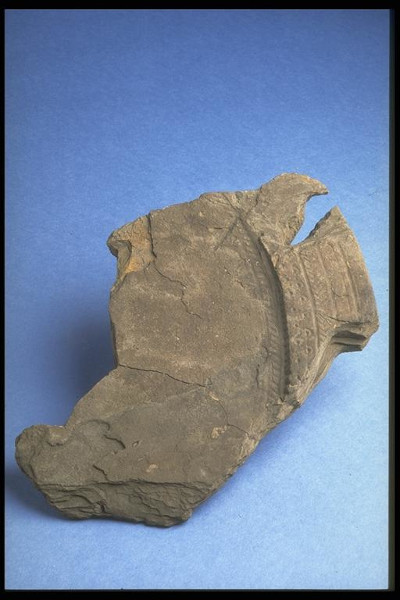
Fragment of shale table top from Silchester
This fragment of a circular top from a small three-legged table is made of shale from Kimmeridge in Dorset. It is decorated with bands of circles and chevrons, and concentric grooves cut into the surface. The table top was found in the Roman town of Calleva Atrebatum, near Silchester in Hampshire. It was excavated by Rev J. G. Joyce, who worked on the site from 1864 to 1878, and later by the Society of Antiquaries, who uncovered more of the town between 1890 and 1909.
As materials, shale and jet can be confused with each other because they are both black or dark brown in colour and can be finely worked. Shale is a common fine-grained rock derived from compressed mud. It is made up of thin layers and can have a high organic content in the form of tiny particles of oil. It needs careful carving and over time can lose its shiny appearance and split. Jet is a gem-quality type of coal, starting out as fragments of softwood which were preserved in wet, low-oxygen conditions (such as swamps) and later heated. It comes from a few places in north-east England as well as sites in Europe. Roman jet was often collected by beachcombing at Whitby! Rings and bracelets made of this semi-precious stone were also found in Calleva.
Museum object number