Steelyard weight Bacchus figure
From Silchester - Roman, 4th century
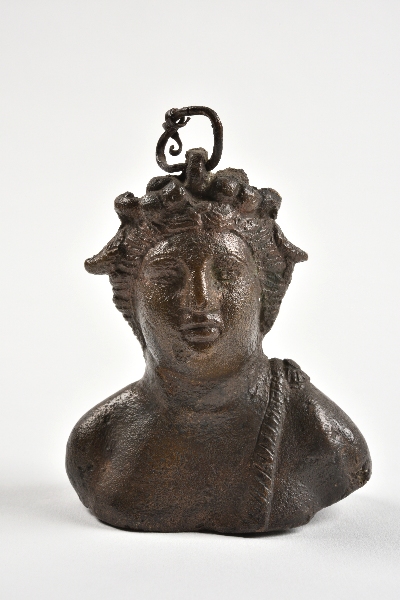
Bacchus figure weight from Silchester
This hollow cast bronze weight represents Bacchus, the god of wine, theatre, pleasure and madness. Bacchus and his worshippers disrupted society’s status quo and crossed gender boundaries. His female followers (known as maenads in Greece and bacchantes in Rome) were often portrayed in a state of ecstatic inebriation and madness. Bacchus himself had both male and female lovers, and was often depicted in art with typically feminine features and clothing. He was commonly shown wearing a headdress of vine leaves and grapes and holding a thrysus: a staff covered with vines and ivy leaves and often topped with a pinecone.
This weight would be used on a steelyard – a scale with beam arms of unequal length. The item to be weighed would be suspended from one arm close to the balance point. The counterweight would be moved along a scale on the arm until the balance was even and the weight indicated.
This object was found with the 1900 hoard of ironwork in Insula XXIII in well 2 at the Roman town of Calleva Atrebatum, near Silchester in Hampshire. The town’s streets formed a grid. A block was known as an insula and archaeologists gave each insula a number. The town was excavated by Rev J. G. Joyce, who worked on the site from 1864 to 1878, and continued by the Society of Antiquaries, who uncovered the town between 1890 and 1909. This large-scale excavation found two hoards of ironwork.
Museum object number