Hexagon pattern mosaic
From Silchester - mid 2nd century
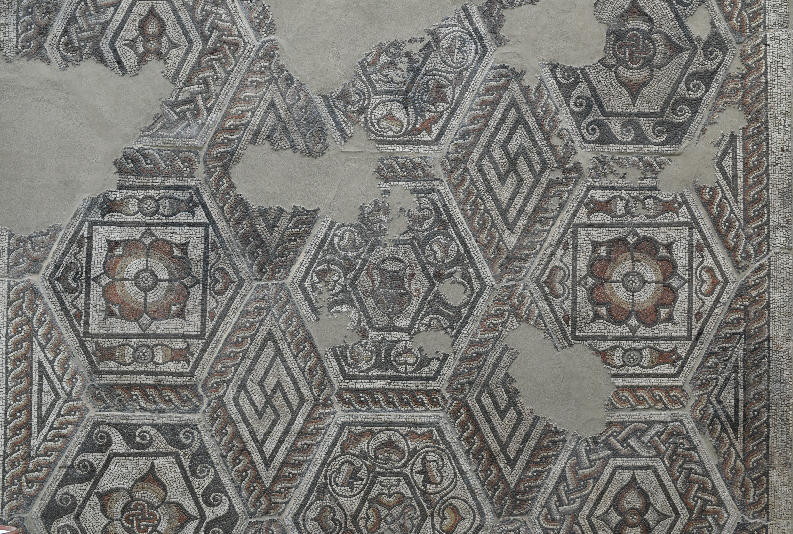
Centre detail of the Hexagon mosaic in the Museum's Atrium
This stone and pottery mosaic floor comes from the Roman town of Calleva Atrebatum, at Silchester, about 10 miles south-west of Reading. The town was established by native tribes in the century before the Roman conquest of AD43. After the conquest, the wealthier townspeople imported luxury items from the continent and adopted many Roman ways. Excavation between 1890 and 1909 by the Society of Antiquaries uncovered many artefacts, including some 13 mosaic pavements.
Mosaic floors are made by setting naturally coloured cubes of stone, glass, tile or pottery, known as tesserae, into mortar to make patterns or illustrations. This one has a design of nine hexagons, of which eight enclose floral images and the central hexagon holds a two-handled wine urn known as a cantharus. It measures about 4.3 metres square. It was one of four mosaics of similar size found in a large house west of the forum (in an area referred to by the excavators as 'insula XIV'), all in rooms of the east wing which was probably built in the mid-second century AD. The owners of this house must have been among the most wealthy and 'Romanised' inhabitants of the town.
The excavators mounted the mosaic in sections on very heavy steel reinforced concrete, and the Museum bolted it onto the wall of a gallery for display, where it remained for almost 100 years. During 1998–9 the mosaic was conserved and the heavy concrete was replaced with a lightweight support system. In March 2000 it was on view again on the wall of the Atrium Gallery, alongside a black and white mosaic from the same wealthy house at Silchester.
Museum object number