Ogham stone
From Silchester - 5th century
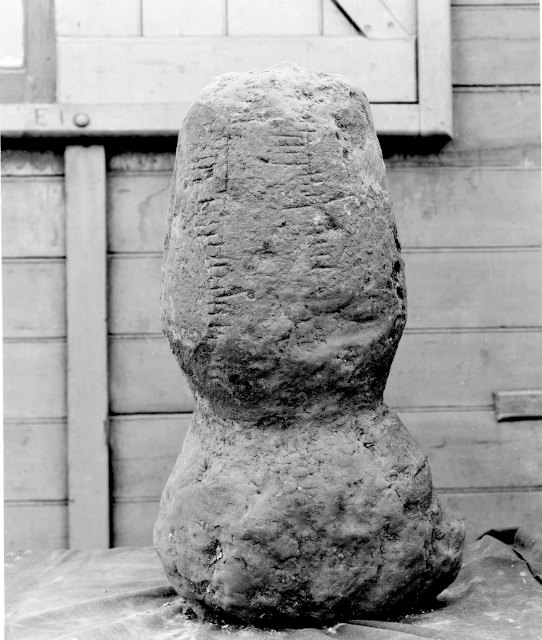
Ogham stone at the time of its discovery in 1893 (print no.1928.244.635)
This battered greensand 'dwarf' column, reused as a property marker, is inscribed in Ogham, a Celtic script in which Latin letters are translated into characters made up of groups of horizontal strokes on a vertical axis. This is the only example of an Ogham inscription found in southern Britain east of the river Severn. It was found down a well in the backyard of a small cottage within Insula IX at the Roman town of Calleva, near Silchester, Hampshire in 1893 by the Society of Antiquaries and had crushed a pewter flagon beneath it.
The inscription on the stone has been translated as 'of Tebicatos, son of the tribe of'. It may refer to Tebicatos's ownership of the property where it was found. This 5th century inscription suggests that there was a larger Celtic community in Calleva which could read Ogham between the 5th and 7th century AD, after the end of Roman rule, and that this community had a link with Wales and southern Ireland.
The stone had probably once formed part of a balustrade on a grander house which had fallen into disrepair.
Museum object number